.
. Siempre habia querido uno y...
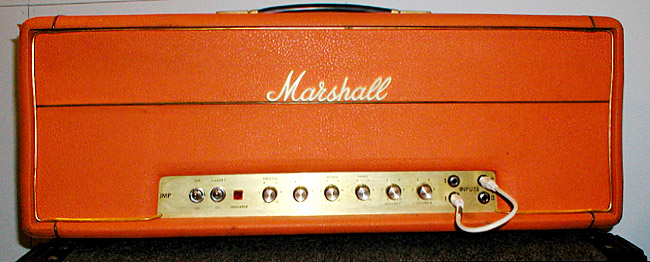
Marshall Super Bass del 75
[img:jxzy6ui6]http://i31.photobucket.com/albums/c373/ ... entero.jpg[/img:jxzy6ui6]
Ya se que solo una 12" no es la mas apropiado. En proyecto esta ponerle una mas adecuada. Una 2x12" minimo.
Cuando me llego a casa lo lleve al local de Rafazappa aun sin desembalar siquiera (tal era el ansión
 ) Lo desembalamos y nos encontramos con el primer problema, del que no me habia percatado antes viendo las fotos. Tenia una entrada de corriente un tanto peculiar. Segun he visto a posteriori es la entrada que llevan hasta el 75/76.
 [img:jxzy6ui6]http://i31.photobucket.com/albums/c373/ ... ctores.jpg[/img:jxzy6ui6]
Se puede ver que es redonda y con tres pines. El tio me mando un adaptador, pero el enchufe era tambien muy raro. Parecia tipo industrial pero no lo habiamos visto en la vida.
[img:jxzy6ui6]http://i31.photobucket.com/albums/c373/ ... /cable.jpg[/img:jxzy6ui6]
Esta es la parte que enchufa en el ampli
[img:jxzy6ui6]http://i31.photobucket.com/albums/c373/ ... nchufe.jpg[/img:jxzy6ui6]
[img:jxzy6ui6]http://i31.photobucket.com/albums/c373/ ... eatras.jpg[/img:jxzy6ui6]
Y este el enchufe
Lo que hicimos fue desmontarlo y poner un enchufe standard.
He visto que lo que hace la gente es cambiar la entrada del ampli por una estandar y no hay que hacerle agujeros nuevos. No pensaba cambiarle la entrada pero es muy habitual que se te olvide el cable de alimentacion cuando llevas el ampli a algun lado y uno como el mio no encuentro ni loco, asi que me lo replanteare.
Ya con el cable recien fabricado lo enchufamos a una 4x12" peavey 5150.
Dejamos que caliente un poco y
 mierda no funciona, se oye un ruido que varia al mover los controles de eq pero no mas... despues de darle unas vueltas dimos con el problema. La primera valvula de previo estaba cascada, es raro porque son mas robustas que las de potencia pero... la cambiamos y la cosa ya funciono, menos mal, el susto que me di fue de aupa.
A muy bajo volumen en el canal brillante (en el otro solo suena demasiado oscuro, puenteados la cosa cambia claro) y con strato tiene un limpio muy bonito y abierto (no me esperaba que empezara a sonar tan pronto), pero le viene bien un compresor, cosa que cuando le das mas alegria al volumen no ocurre, normal. A bajo volumen con dobles no me convencio demasiado.
Acto seguido caña, puenteamos los dos canales, todos los controles de eq a tope (es como mejor me suena, en la 1x12" con los agudos un poco recortados si no le das mucha chicha, normal tambien) y el volumen alegre.
 joder que miedo, esa es la sensacion que da, MIEDO, antes siquiera de tocar, los armonicos parece que se van disparar solo con agitar la guitarra, y se le oye respirar. Es como tener una enorme bestia a punto de estallar. Acojonante. Un volumen bestial, demasiado sinceramente. "Demoliciones Marshall"
El tipo de sonido que da a Rafa le recordo mucho a los Free.
No se como explicaros el sonido que tiene, solo puedo deciros que me gusta y mucho.

Tiene algun problemilla de ruiditos por las valvulas, que estan mas palla´ que paca´, y seguramente le vendria bien una puesta a punto, ya que todos los componentes, incluidos condensadores parecen originales. Algunos potes rascan un poco... lo tipico en un ampli de su edad supongo.
Algunas fotos:
[img:jxzy6ui6]http://i31.photobucket.com/albums/c373/ ... cabeza.jpg[/img:jxzy6ui6]
Como veis el ultimo boton no es original. A ver si consigo uno.
[img:jxzy6ui6]http://i31.photobucket.com/albums/c373/ ... erbass.jpg[/img:jxzy6ui6]
No se ve el numero de serie con el flash, 5030G.
[img:jxzy6ui6]http://i31.photobucket.com/albums/c373/ ... afecha.jpg[/img:jxzy6ui6]
La etiqueta con la fecha y la firma del tio que lo reviso
[img:jxzy6ui6]http://i31.photobucket.com/albums/c373/ ... cuito4.jpg[/img:jxzy6ui6]
[img:jxzy6ui6]http://i31.photobucket.com/albums/c373/ ... cuito3.jpg[/img:jxzy6ui6]
El circuito, si veis alguna cosa rara decidme.
[img:jxzy6ui6]http://i31.photobucket.com/albums/c373/ ... elente.jpg[/img:jxzy6ui6]
[img:jxzy6ui6]http://i31.photobucket.com/albums/c373/ ... chasis.jpg[/img:jxzy6ui6]
Y el chasis, ahora esta con dos valvulas menos de potencia, pero sigue dando un volumen desmedido. El capuchon de la de previo que falta me lo quede en casa de Rafa...

Yo de momento he comprado un atenuador THD Hot Plate, aun no me ha llegado, ya os comentare que tal.
Y muchas gracias a Dani (dbsanz) que me hecho un cable con el ampli

Esto es un poco de la historia de mashall sacada de la pagina oficial:
[url:jxzy6ui6]http://www.marshallamps.com[/url:jxzy6ui6]
The history of Marshall amplifiers has become a source of great fascination and interest over three decades. In 30 years of manufacturing we have made a vast number of different models using many materials and techniques. Documentation from those early years is virtually non-existent. The pressure to build amplifiers was so great that detailed record keeping was impossible. This pressure also created anomalies in the products themselves as component and minor cosmetic changes could be phased in at any time where supplies ran out but production had to continue.
The following information is a rough guide to the major changes in the most popular Marshall models since 1962.
1962 - The original production of those first JTM45 models featured the following:- Serial numbers starting at 1004; Smooth black covering: White grill cloth: Silver polished aluminium panels: No rear panel: Rectangular metal logo with red block lettering: Leather handle: Single speaker output: 5881 or 6L6 valves. Cabinets - Straight fronted, using the same logo and fret cloth: Celestion G12 15 speakers.
1963 - Production essentially the same as the above but with the following changes:- Twin speaker outputs: Black knobs with serrated edges: Changed to white engraved panels late in 63: First angled cabinets, similar finish and speakers to the straights but taller than today's 4x12.
1964 - Serial numbers begin with 2: Valves now changed to KT66's: Logo changed to gold plastic with black lettering mid year: The first combos made late 64: Speakers now changed to G12 20's.
1965 - Panel changed to gold plexi glass: Serial numbers no longer reliable: Handles changed to plastic with larger end cap: The first 100 Watt amps appeared in larger cabinets with two 50 Watt transformers, JTM45 panels, KT 66 valves and without GZ34 rectifier. The first serious combo production of models 1961 4x10 and 1962 2x12 took place. The same features as the JTM45 but with the addition of tremolo. Fret cloth changed to green flecked weave late 65. The 'stack' was born from Pete Townshend's original request for an 8x12 cabinet. Late 1965 saw the change to green fret cloth.
1966 - TheJTM45 changed to JTM50 on panels: Block logos now changed to white script with gold coloured plating: Valves changed to EL34's and Gz34 rectifier phased out: Transformer uprated. 100 Watt production was now standardised with a single 100 Watt transformer and EL34 output valves. The 1961 and 1962 were upgraded in line with the heads and cabinets slimmed down. All cabinets now had corner locked joints. As a method of quality control all cabinets were signed inside.
1967 - Chassis were all upgraded from aluminium to steel construction. The first 200 Watt Majors appeared, with just treble, bass and volume controls, "active" tone circuitry and KT 88 valves. 10 and 18 Watt combos introduced in 1x12, 2x10, 2x12 tremolo or non tremolo versions. Fret cloth on cabinets changed to basket weave in late '67.
1968 - The Major was modified to match the normal panel layout and active electronics dropped. Gold logos changed to white.
1969 - New gold metal panels were introduced across all ranges. Serial numbers now followed a dating system with the letter A appearing after the number.
By 1970, cabinets had all changed to check fret cloth. From this point onwards, Marshall amplifier history is much more easily accessible from the serial number and the inspection tag attached to every amp chassis. Notable dates after 1970 are as follows:
1970 - The period of coloured Marshalls. Orange, purple, blue etc.
1974 - The first transistor 100 Watt amp (model 2098) was introduced.
1975 - Design of the first Master Volume amp was completed.
1976 - All units changed to thicker wood finish and large white script logos. Black fret cloth gradually introduced.
1981 - JCM 800 range launched.
1982 - The first split channel amps arrived.
1987 - 25/50 silver Jubilee units produced.
1989 - Series 9000 rack systems released.
1990 - The year of JCM900.
1991 - Valvestate swept the world.
1992 - The 30th Anniversary.
En esta direccion hay galeria de fotos, modelos discontinuados y algo de la historia de Jim Marshall.
[url:jxzy6ui6]http://www.blamepro.com/mar/history.htm[/url:jxzy6ui6]
En esta pagina EN ESPAÑOL, viene informacion, esquemas y bastante ayuda para quien se quiera construir uno. Supongo que la mayoria la conocera
[url:jxzy6ui6]http://www.plexilandia.cl/[/url:jxzy6ui6]
En el google se encuentra tambien muuucha informacion


 enhorabuena por la compra