[quote="Rafael Marín":udkqz857]Me parece un mástil horrible........... feo feo feo, de verdad....... :periódico:[/quote:udkqz857]
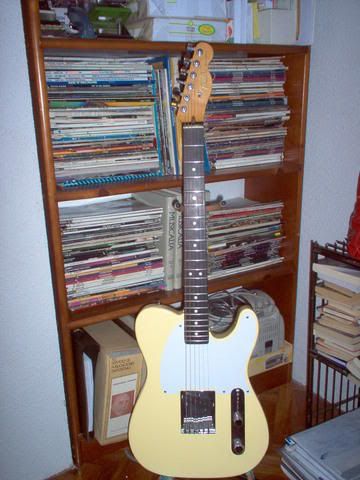
Referente a esto tengo mis reparos, al igual que tu rafa, no me gusta el arce de ojo de pájaro para el mástil

.
Creo definitivamente que esta replica de la CS, que históricamente reproduce la que se presento en la feria de la NAMM de 1950, tiene ciertas diferencias en cuanto al arce del mástil a las que comercializaron entre Junio y hasta Octubre del mismo año 1950, cuando salio del mercado para re aparecer en 1951.
Me da idea mirando las fotos, que el ojo de pájaro se ocupo exclusivamente para la que presentaron a la NAMM, y las que comercializaron en este periodo tienen su mástil hecho en arce solidó de una sola pieza sin ojo de pájaro, flameado, ni nada parecido.
Este patrón para presentaciones de sus nuevos productos en Ferias y eso, es una política a la cual Fender solía recurrir (no se ahora si es así), pero siempre se trataba de modelos en cierta formas especiales y que se diferenciaban a los que mas tarde salían al mercado “Común”.
De todas formas, sea como sea, el ojo de pájaro no me gusta para nada, no lo encuentro bonito para Teles.
Referente a esto, encontre esta información que me parece pertinente compartir con ustedes:
---------------------------------------------------------------------------------
[b:udkqz857]Spring 1950 to late summer 1950 NAMM Esquire Introduction specs: [/b:udkqz857]
1 or 2 pickups, but the one pickup "Single Esquire" appeared first, followed by the two pickup "Double Esquire".
Black laminated Pine body on first few Single Esquire examples, then changed to butterscotch blond on an Ash body during the summer of 1950.
Maple one piece neck with no truss rod on early examples, but a truss rod appeared on some late summer 1950 Esquires.
Serial number on bridge plate (earliest documented number 0013).
Steel bridge saddles on non-truss rod models, or brass on later models.
Steel brige pickup grounding plate with two wire notches in the pickup's black base.
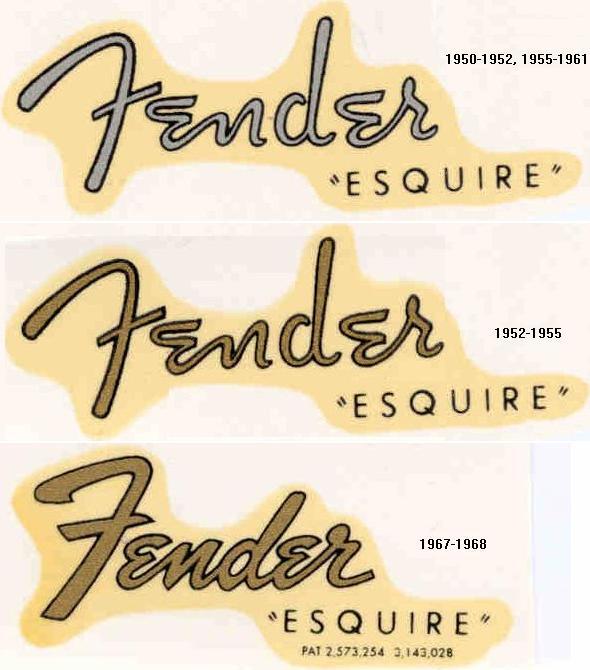
Silver or gold "spaghetti" Fender peghead logo with black trim.
No string tree.
White pickguard on black Equires, black vulcanized fiber (often called "bakelite") pickguard (clear coated with lacquer) on blond bodies.
Round Dakaware switch tip with "Pat Pend".
Often the rear string ferrels are not aligned.
Some models use a maple plug (instead of walnut) on the peghead for the truss rod.
Peghead truss rod plug is more rounded.
Body date in neck pocket, usually no neck date.
Knurled chrome plated brass knobs with a semi-flat top.
Two patent number 3-way switch CRL 1452 (2291516, 2291517).
Stackpole pots (manufacturer number 304).
Blend control pickup wiring (no tone control).
All screws have slot heads (including the truss rod adjuster).
Brown rectangle Cornell Dubilier paper tone capacitor and brown tube paper tone caps used, plus a single carbon resistor (on two pickup models).
Kluson Deluxe tuners with "Kluson Deluxe" in a single vertical line (aka "single line"), no second hole on side of gear shell (for the tuner peg), "pat. appld." on side bottom side of gear shell and "pat appld 2356766" on tuner bottom.
Milled chrome plated brass jack cup with ribbing on sides to hold jack inside the body hole - no other attachment method used.
A guess is that about 60 pre-1951 Esquires were made.
---------------------------------------------------------------------------------
[b:udkqz857]Fall 1950 discontinued and replaced by the Broadcaster. No Esquires made from late September 1950 to January 1951. [/b:udkqz857]
---------------------------------------------------------------------------------
[b:udkqz857]January 1951 Esquire re-introduction specs (same specs as above, except): [/b:udkqz857]
Single pickup (though a dual pickup 1/51 Esquire has been seen).
Butterscotch Blond finish on ash body.
Round button string tree.
Brass bridge saddles.
Brass brige pickup grounding plate.
Single flat pole pickup in treble position.
Silver or gold (but most were gold) Fender "spaghetti" peghead logo with black trim.
Lead pickup wrapped with white string, and then the pickup is potted in wax (often making the white string look black).
Kluson Deluxe tuners with NO "Kluson Deluxe" in a single vertical line (aka "no line"), no second hole on side of gear shell (for the tuner peg), NO "pat. appl" on side bottom side of gear shell (moved to underside of tuner base).
"D" stamp often seen in the neck pocket and/or neck heel of 1951 to 1954 Esquires.
---------------------------------------------------------------------------------
[b:udkqz857]1952 Esquire specs: [/b:udkqz857]
Gradual use of phillips head screws replaces slot head screws (this change was not complete till 1953).
Kluson Deluxe tuners with NO "Kluson Deluxe" in a single vertical line (aka "no line"), ADDED second hole on side of gear shell (for the tuner peg).
Knurled chrome plated brass knobs with a round top.
Lead pickup no longer has the two wire notches in the black pickup base.
By late 1952 a pressed jack cup replaced milled jack cup. An added internal metal plate is used inside the body jack hole to secure milled cup.
Walnut peghead truss rod plug is more oval shaped.
---------------------------------------------------------------------------------
[b:udkqz857]1953 Esquire specs: [/b:udkqz857]
Neck fingerboard dots change spacing. On pre-1953 models, dots are about 1" (center to center) apart at the 12th fret. On 1953 and later models, the dot spacing is about 1 1/8" center to center.
Again silver or gold Fender "spaghetti" peghead logo with black trim, (but most seem to be gold).
Flat-side ("poodle") guitar-shaped cases used during 1953.
---------------------------------------------------------------------------------
[b:udkqz857]Mid 1954 Esquire specs: [/b:udkqz857]
Serial number on neck plate.
Blond body finish has a more whitish look than the earlier "butterscotch" finish. In reality, the body finish was probably applied no differently, but the type of clear lacquer used to clearcoat does not yellow as much This gives mid-1954 and later Teles a more whitish blond look, instead of butterscotch. Because of the more whitish look, a distinct "halo" can be seen around the edge of the body that is less translucent (this halo was present on the earlier butterscotch finishes, but it was far less noticable).
The halo was used to hide the side grain of multi-piece bodies, because Fender could easily match the face grain, but it was difficult to match the side grain.
White single layer ABS pickguard .060" thick replaces black pickguard.
Bridge saddles change from brass to small steel smooth saddles with rough finished ends. Also the angle of the string height screws changed to be about 45 degrees.
Daka-Ware "Top Hat" style switch tip starts to be used instead of the round tip.
"D" neck/body stamp is largely not seen after 1954 (except on an occassional neck up 1957).
---------------------------------------------------------------------------------
[b:udkqz857]Mid 1955 Esquire specs: [/b:udkqz857]
Staggered pole pickup magnets replace the previous "flat pole" pickup in the treble position.
Sunburst finish on ash body available, but very few made.
Body date moved from neck pocket to under lead pickup (late 1955).
Silver "spaghetti" peghead logo with black trim (gold is no longer used).
"Top Hat" style switch tip used exclusively.
---------------------------------------------------------------------------------
[b:udkqz857]Mid 1956 Esquire specs:[/b:udkqz857]
String tree changes from round button to "butterfly" clip.
String tree moved closer to the nut, roughly in alignment with the A-string tuning "Single Line" Kluson Deluxe tuners (which says "Kluson Deluxe" in a vertical line).
Peghead decal position changes to between the nut and the string tree (rather than next to the G-string tuning post).
Neck backshape gets a large "soft V" shape.
Metal control knobs change from a chrome plated brass course knurl rounded top design, to a fine knurl flat top pot-metal knob.
--------------------------------------------------------------------------------
[b:udkqz857]1957 Esquire specs:[/b:udkqz857]
Most 1957 Esquires have a neck with a "strong V" backshape.
Sunburst finish done on a small batch of Esquires, and then discontinued.
--------------------------------------------------------------------------------
[b:udkqz857]1958 Esquire specs: [/b:udkqz857]
Bridge saddles change from smooth to threaded saddles.
Strings anchor at bridge ("top loading") instead of going thru the body (late 1958).
---------------------------------------------------------------------------------
[b:udkqz857]Mid 1959 Esquire specs: [/b:udkqz857]
Slab Rosewood fingerboard.
White .080" thick single layer pickguard, except on certain custom color models which got a 3 layer celluloid mint green pickguard.
Esquire Custom introduced with 3 layer celluloid mint green pickguard.
Brown paper rectangle tone cap changes to a white "chicklet" paper tone capacitor.
---------------------------------------------------------------------------------
[b:udkqz857]1960 Esquire specs: [/b:udkqz857]
Strings anchor thru the body again, but bridge is still drilled for top loading strings.
---------------------------------------------------------------------------------
[b:udkqz857]1961 Esquire specs: [/b:udkqz857]
White "chicklet" paper tone capacitor and tube paper tone caps change to red round disc capacitors.
---------------------------------------------------------------------------------
[b:udkqz857]Mid 1962 Esquire specs: [/b:udkqz857]
Veneer Rosewood fingerboard.
---------------------------------------------------------------------------------
[b:udkqz857]Late 1962 Esquire specs:[/b:udkqz857]
Neck pocket no longer entirely painted. Instead a "paint stick" (a piece of wire conduit hammered flat) is used to hold the body during the painting process. This leaves a bare area on the bass side of the neck pocket with no paint.
Last of the drilled top loading bridges used up.
---------------------------------------------------------------------------------
[b:udkqz857]Mid 1963 Esquire specs: [/b:udkqz857]
Peghead logo (still silver "spaghetti" with black trim) adds a DES 164,227 and two patent numbers of 2,573,254 and 2,784,631.
12th fret neck dot markers moved closer together.
---------------------------------------------------------------------------------
[b:udkqz857]Fall 1964 Esquire specs: [/b:udkqz857]
Pearloid fingerboard dots replace "clay" dots (this transitioned into early 1965).
Pickup changes from "black bottom" to "gray bottom" (again this transitioned into 1965).
Tuners change from "single line" Kluson Deluxe to "double line" Kluson Deluxe (where "Kluson" and "Deluxe" are now in two vertical parallel lines).
Pickguard changed to a white plastic W/B/W three layer laminted plastic.
---------------------------------------------------------------------------------
[b:udkqz857]Late 1965 Esquire specs: [/b:udkqz857]
Glued-on Maple fingerboard available as an option (black dots), with no back skunk stripe.
---------------------------------------------------------------------------------
[b:udkqz857]Mid 1967 Esquire specs: [/b:udkqz857]
Peghead logo changes to a thicker gold "transition" logo. The DES number is dropped, but has two patent numbers 2,573,254 and 3,143,028.
Glued-on Maple fingerboard with no back skunk stripe "officially" available, even though in practice it was readily available in 1965 and 1966 (no skunk stripe).
---------------------------------------------------------------------------------
[b:udkqz857]1968 Esquire specs: [/b:udkqz857]
White plastic three layer pickguard replaces thick single layer pickguard.
"F" style tuning gears replaces Kluson-Deluxe gears.
Polyester thick finish replaces nitrocellulose lacquer.
String ferrules on back now stick out, no longer flush.
Black Fender decal replaces "transition" logo with the two patent numbers moved to under the "Fender" part of the logo (mid-1968).
Still using one string tree on the peghead.
[b:udkqz857]1970 Esquire discontinued. [/b:udkqz857]
---------------------------------------------------------------------------------
Suerte






 Parece lógico pues que solo salieran acabadas en negro, si la pretensión es reeditar aquellas primeras fielmente, no?


 . Si la venden como replica, que sea exacta y fiel a la original y no la promuevan con esa publicidad si sabemos tiene algunas diferencias, por muy mínimas que sean.

 .
.
 y que conste en acta que no soy ningún bujarrón ein???